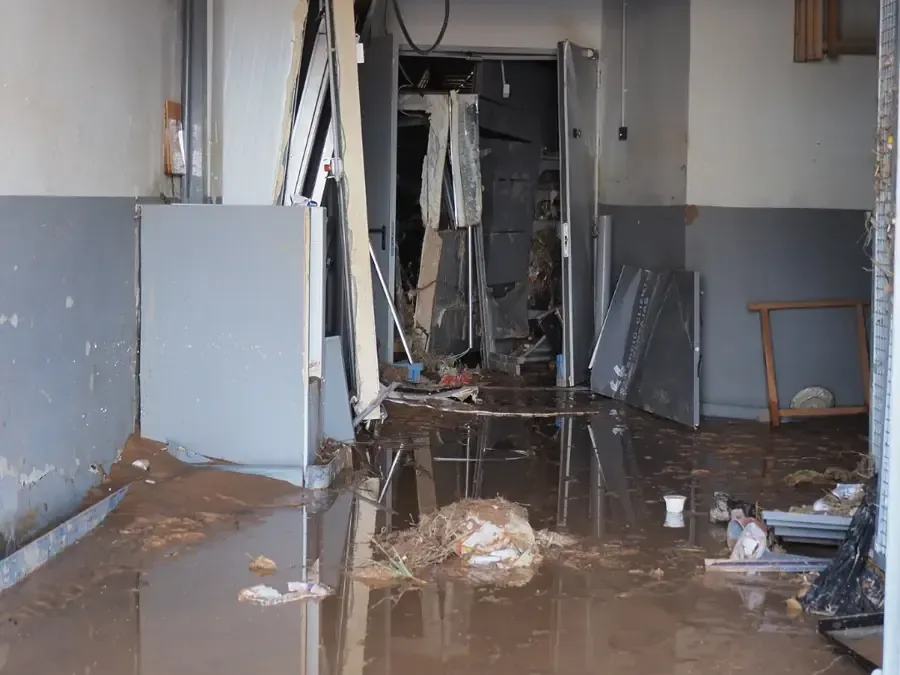
News reports put the rain in Leominster near 10 inches in a few hours during the September 2023 cloudburst, and the water flooded streets and basements. A storm that fast outruns the ground, the gutters and the storm drains all at once. The sections below explain how a cloudburst fills a basement, what a household does first, and how the restoration crew pumps out and dries block and fieldstone walls.
Key takeaways
- A cloudburst can put water in a basement faster than the ground and the drains can take it, as the September 2023 storm showed.
- Many older houses have fieldstone or block basement walls, which have many joints for water to use and can hold moisture after the surface looks dry.
- Standing water near the electrical panel, the furnace or the water heater is a shock risk, so the power goes off first, from a dry spot or by an electrician.
- Storm water is not clean, so soaked carpet, pad and insulation usually come out, while hard surfaces are cleaned and dried.
- Photos of the water level and a short written note, made before anything moves, give the cleanup plan a clear starting point.
How a cloudburst fills a basement here
Rain that falls this fast cannot soak into ground that is already saturated, so it runs across yards and driveways to the lowest spot. In an older house, the lowest spot is often a stairwell, a window well or the joint where the floor meets the wall.
Monoosnoc Brook runs through downtown, the North Nashua River runs along the east side and Fall Brook is another local waterway. In a cloudburst, the brooks and storm drains take on the same water the yards are shedding.
Water that comes in from above
Surface water enters at doors, bulkheads, window wells and low windows. It arrives fast and brings yard soil along with it.
Water that comes up from below
Saturated soil pushes water through floor cracks and along the edge of the slab. A floor drain can also bring water up when the storm drains are full, and that water is treated as contaminated.
Why fieldstone and block walls take water differently
Full basements are the norm across the city, and many have fieldstone or block walls, especially under the older two and three family houses near downtown. Both wall types are built from many pieces with joints between them, so water has many small ways through.
Hollow block cores can fill and hold water that a surface check misses. Mortar between fieldstones can weep for days after the rain stops.
- Wood sills, posts and stair stringers sit on the floor and wick water upward.
- Stored boxes, furniture and electronics on the floor soak up water from below.
- A wall that looks dry on the surface can still read wet inside.
- Paneling and framed finished walls trap water against the foundation.
Water still spreading? Shut off the main if it is safe. The restoration team extracts, dries to the IICRC S500 goal and documents every step, 24/7.
(888) 629-3140Get the extraction crew movingThe first day after the water arrives
Safety comes before cleanup. A basement holds the electrical panel, the furnace and often the water heater, and standing water near any of them is a shock risk.
- Stay out of the water until the power to that part of the house is off, and bring in an electrician if water reached the panel.
- Photograph the water level on the walls and the items that got wet before anything moves.
- Carry electronics, papers and boxes to dry shelves from a safe spot on the stairs.
- Skip the mop for anything deeper than a puddle, because water extraction moves far more water than towels can.
- Keep children and pets out of the basement until the water is gone.
What the restoration crew pumps, removes and dries
The crew starts with the standing water. Truck mounted and portable extractors pull it off the floor, and submersible pumps clear deeper water.
Pumping and removal
Storm water crosses yards and streets before it reaches the house, so the crew treats it as contaminated. Soaked carpet, pad, insulation and the lower part of wet drywall usually come out, which is a large part of basement flooding cleanup.
- Usually removed: carpet and pad, soaked insulation, wet drywall near the floor and particleboard.
- Usually kept, cleaned and dried: the concrete floor, block and stone walls and solid wood framing.
Moisture mapping and drying
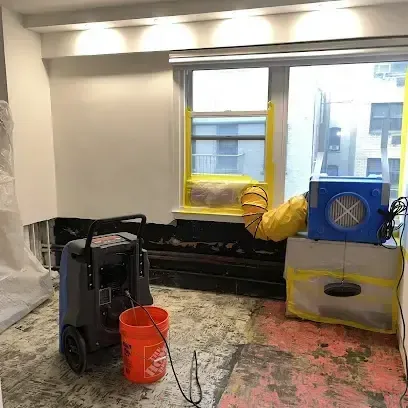
Once the water is out, the crew maps moisture across the floor, the bottoms of the walls and the framing with a meter. Dehumidifiers and air movers then run until the readings come down, a process called structural drying.
Drying fieldstone and block walls to a measured goal
A wall is dry when the meter says so, not when the surface looks dry. The crew takes readings at the start and compares them with a reference reading from a dry part of the same house.
Stone and block hold water longer than drywall, so the equipment stays until the readings level off. The goal follows the IICRC S500 standard, which covers how drying is measured and documented.
- Readings are retaken at each visit and written down.
- Equipment moves when a reading stalls in one spot.
- Wet framing behind finished walls may need openings so air can reach it.
- The crew removes the equipment only when readings match the dry reference.
Mistakes that make a flooded basement worse
A few well meant steps cost more than they save. The mistakes below come up often after a fast flood.
Speed matters, but order matters more. Safety comes first, then extraction, then drying, and repairs come last.
- Walking through the water to rescue items while the power is still on.
- Running a household vacuum on standing water, which is a shock risk and ruins the machine.
- Turning on a furnace or water heater that sat in the water before a technician checks it.
- Closing a wet room and leaving it, which gives damp materials time to break down.
- Painting or paneling over damp walls before the readings are dry.
Getting ready for the next cloudburst
No basement is proof against a storm that drops 10 inches in a few hours, but a few checks cut the odds. A pump that quits mid storm is the usual start of a sump pump failure cleanup, so the pump is the first thing to test.
After a flood, storm flood cleanup can also include the yard side of the problem, such as gutters and grading.
- Clear gutters and send downspouts well away from the foundation.
- Keep window wells and stair drains clear of leaves.
- Pour water into the sump pit before storm season and watch the pump start, and think about a battery backup.
- Raise stored items onto shelves and keep nothing valuable on the floor.
- Learn where the main water shutoff and the electrical panel are.
Questions
How soon does a flooded basement need attention?
Wet carpet, pad and drywall start to break down in the first 24 to 48 hours, so extraction and drying start as early as possible.
Is storm water in a basement safe to clean by hand?
Storm water carries soil and bacteria from the surface, so it is not treated as clean. A small amount can be handled with gloves and boots, but a deep or widespread flood calls for extractors and protective gear.
Can a finished basement be saved after a cloudburst?
Often the hard surfaces and framing can be saved. Carpet, pad, insulation and the bottom of wet drywall are the usual losses.
Why does a basement stay damp after the standing water is gone?
Stone, block and wood hold moisture long after the surface dries. Only meter readings show whether the walls and framing are done.
What should be written down before the cleanup begins?
The time the water was noticed, how high it rose and which items got wet. Photos of each help the crew plan the work.
Can a household vacuum be used on a wet basement floor?
No. A household vacuum is not made for standing water, and using one near wet floors and outlets is a shock risk. Only a wet vacuum made for water belongs near a flooded floor, and even that waits until the power is off.
