A leak in one apartment rarely stays in that apartment. In an older two or three family house, the floors, pipes and drains are shared, so water follows the structure down to the next unit. The sections below explain why, what each household does first, and how the restoration crew dries more than one apartment at once.
Key takeaways
- In a stacked house, water from an upstairs leak often shows first as a stain on the ceiling of the unit below.
- Older multi family houses near downtown often combine galvanized supply pipes with cast iron drain stacks, and both can fail at joints, elbows and fittings.
- Water travels along joists, inside wall cavities and down pipe chases, so the wet area is usually larger than the visible stain.
- Shutting off the water to the leaking unit stops new water, and extraction and drying in both units should begin together.
- The drying plan covers every floor the water reached, with moisture readings taken in each unit.
Why a leak travels through a two or three family house
The city has a large stock of older two and three family houses, mostly near downtown. In many of them, kitchens and bathrooms can sit above one another, so one drain stack or supply riser serves several floors.
Water follows gravity and the easiest path. It runs along the top of a ceiling, drops through gaps around pipes and light fixtures, and slides down the inside of walls.
Along the floor framing
Water spreads sideways along joists and between the subfloor and the ceiling below. The stain on the ceiling often sits far from the actual leak.
Inside pipe chases and walls
A hollow wall or a chase around a pipe works like a chimney for water. It can carry a leak past one floor and into the next, leaving the middle floor wet inside the wall.
What the household below sees, and when
The household below usually notices the damage in stages, and each stage points to how much water traveled. A stain can appear days after the leak starts, because water first soaks the framing and the insulation.
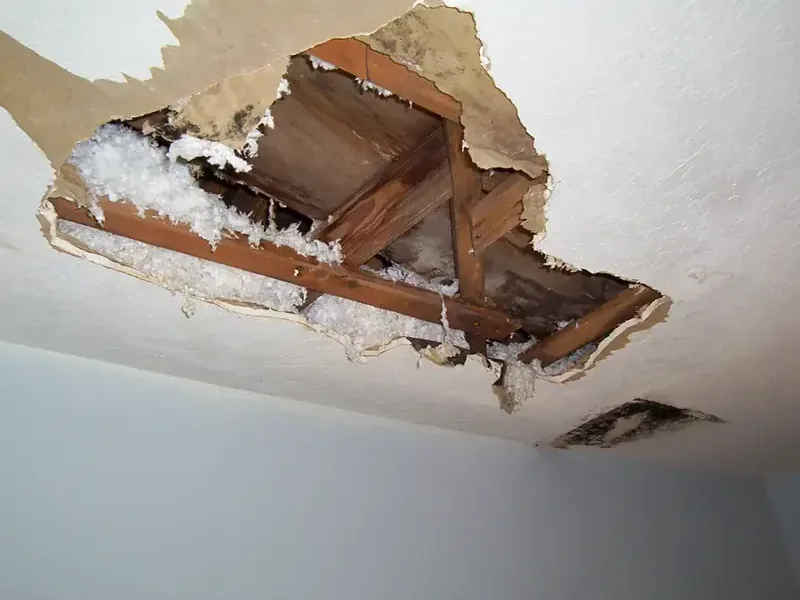
A sagging ceiling is an urgent sign. Wet drywall and insulation are heavy, and a ceiling that sags can fall.
- A brown or yellow stain that grows on the ceiling.
- Paint that bubbles, peels or blisters.
- A sagging or bulging section of ceiling.
- Drips from a light fixture or a vent.
- A musty smell in a room that looked dry a day ago.
- Warped or cupped flooring near an outside wall.
Water still spreading? Shut off the main if it is safe. The restoration team extracts, dries to the IICRC S500 goal and documents every step, 24/7.
(888) 629-3140Get the extraction crew movingOld pipes, shared stacks and the usual failure points
Plumbing in older houses here can include galvanized supply pipes and cast iron drain stacks. Galvanized pipe rusts from the inside and can fail at its threads, while cast iron can crack or weep at its joints.
When a supply pipe splits, the result is burst pipe water damage that runs until someone finds the shutoff. Fixtures add their own weak points, and a leak often starts in a spot nobody sees until the stain appears.
- Supply pipe joints and elbows where galvanized pipe has corroded.
- Drain stack hubs and cracks in cast iron.
- Toilet seals and tub drains on the floor above.
- Washer hoses and dishwasher connections.
- Pipes in exterior walls and unheated corners that split in a freeze.
The first steps in the unit above and the unit below
Both households have a job, and the order matters. The first goal is to stop new water, and the second is to stay safe around electrical fixtures in a wet ceiling.
Water extraction in both units can begin while the plumber works on the pipe.
In the unit with the leak
- Shut off the water at the nearest fixture valve or at the unit's own shutoff.
- If the source is a drain, stop using the sink, tub or toilet.
- Move rugs and furniture off wet floors.
- Tell the other households in the house right away.
In the unit below
- Turn off power to any room where the ceiling is dripping or bulging.
- Keep clear of a ceiling that bulges, because it can drop water and plaster without warning.
- Set out buckets and cover furniture with plastic.
- Photograph the stain and the damage before anything is cleaned up.
Opening ceilings and walls to find where the water went
A ceiling stain only shows the lowest point of the wet area. The crew checks the surrounding area with a moisture meter and an infrared camera to learn how far the water reached before anything is cut.
A ceiling that holds water often needs a small opening so the trapped water drains in a controlled way. For a ceiling leak, wet insulation and sagging drywall come down, and the cavity stays open so air can reach the framing.
- Sagging or stained drywall is cut out and removed.
- Wet insulation above the ceiling is taken out.
- Framing and subfloor stay in place and are dried.
- Walls along the route of the water are opened at the bottom to check the cavity.
Drying across more than one apartment
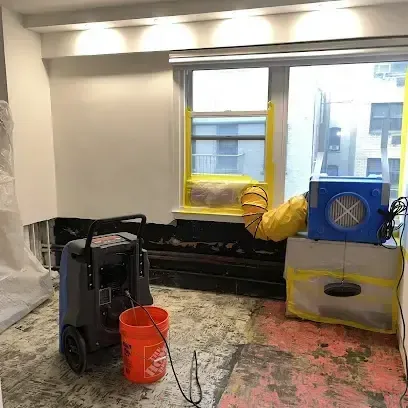
Drying has to cover every floor the water touched, so the crew sets equipment in the unit with the leak, the unit below and sometimes the one under that. Each apartment gets its own readings, and each household has to allow access on drying days.
Air movers and dehumidifiers in one unit do not dry the next one. That is why structural drying follows readings from every affected room, not just the room with the stain.
- Equipment is placed unit by unit, based on readings.
- Each visit adds new readings, and the crew moves equipment as they change.
- Hallways and stairwells are checked if water reached them.
- The drying ends only when each room reads dry.
Preventing the next leak in a multi family house
Most leaks give early signs. A quick check of the places where water starts catches many of them.
- Replace rubber washer hoses with braided ones every few years.
- Look under sinks and around toilets for damp spots or soft floors.
- Learn where each unit's shutoff valve sits and mark it.
- Report a stain or a drip to the owner right away, even a small one.
- Keep a note of any past leaks so the next crew knows where to look.
Questions
How long does a ceiling take to dry after a leak above it?
The time depends on how much water reached the cavity and what the materials are. Readings, not a calendar, decide when it is done.
Why is the middle floor damp when the leak was on the top floor?
Water can run down inside a wall or pipe chase and come out lower. The middle floor can be wet inside the wall without any visible stain.
Should every unit be checked even if only one shows damage?
Yes. Readings in the neighboring rooms and units show whether water traveled past the visible stain.
What comes first after a pipe splits?
Shut off the water to stop the flow, then call for water extraction and a plumber. Both can work at the same time.
When does a sagging ceiling need attention?
Right away. Wet drywall and insulation are heavy, and a ceiling that sags can drop water and debris without warning. Keep people out of the room and shut off power to it.
Can a plumber alone fix the damage?
A plumber repairs the pipe, but the wet drywall, insulation and framing still need extraction and drying. The two jobs run side by side.
